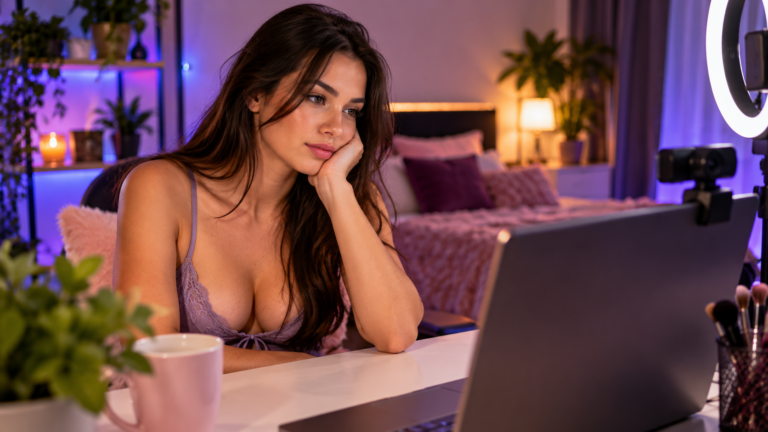
Slow cam days happen, even when your setup, schedule, and approach have worked well in the past.
A quiet session doesn’t automatically mean something is wrong with your account, your appearance, or how you work. Viewer activity can vary from one session to another, and income can vary with it. The useful response is to avoid judging your entire performance from one slow shift and instead look for patterns over time.
The goal on a slow day is not to force activity. It is to stay professional, use the quieter time well, and collect enough information to decide whether anything actually needs changing.
First, Don’t Panic Over One Quiet Session
It is easy to react too quickly when a room feels unusually slow.
You may be tempted to lower your prices, stay online much longer than planned, completely change your schedule, or assume viewers have lost interest.
One session usually does not give you enough information to make those decisions.
Cam income can vary considerably from day to day. Looking at several weeks of results is generally more useful than comparing one good day with one bad one.
Keep Your Room Welcoming
A quiet room can affect your mood, and viewers who arrive may notice.
Try to avoid spending the session complaining about low traffic, repeatedly asking for tips, or commenting on how little you have earned.
Instead, keep the room comfortable for the people who do arrive.
You can greet viewers, make light conversation, adjust your music, talk about something you are interested in, or maintain a relaxed presence.
You do not need to perform at full energy every second. The goal is to give a new viewer a reason to stay long enough to understand what your room is like.

Use Slow Periods to Talk With Viewers
When your room is busy, it can be difficult to give individual viewers much attention.
A quieter session can give you more time to talk.
Ask simple questions. Respond to chat. Recognize returning usernames when you genuinely remember them. Let conversation develop naturally rather than turning every interaction into a sales attempt.
That can be useful over the longer term because returning viewers often matter more than a single burst of traffic.
Check the Basics Before Changing Your Strategy
Sometimes a slow session really is just a slow session.
But it is still worth checking that there is not a simple technical or presentation problem.
Look at Your Stream as a Viewer Would
Check:
- Is the picture clear?
- Is your lighting flattering rather than too dark or harsh?
- Can viewers hear you properly?
- Is your camera positioned well?
- Is your internet connection stable?
- Is anything distracting visible in the background?
These are small checks, but they can prevent you from trying to solve a traffic problem when the real issue is technical.
Do not assume you need new equipment. Often, changing a light position, camera angle, microphone level, or background is enough.
Avoid Immediately Dropping Your Prices
Reducing prices can feel like an obvious way to attract activity when a room is quiet.
But one slow day isn’t enough evidence that your pricing is wrong.
If you repeatedly lower prices whenever traffic falls, it becomes difficult to learn what viewers are actually willing to pay.
Instead, review your pricing over a longer period. Consider how often viewers choose private sessions, how long those sessions last, your total working time, and the amount you actually receive.
Changes based on repeated patterns are more useful than changes made out of frustration.
Don’t Automatically Stay Online for Hours Longer
Another common reaction is to keep extending a slow session.
Sometimes staying a little longer makes sense. Traffic can change during the day.
But at some point, adding hours turns a slow three-hour session into a slow six-hour session.
Set a reasonable session length before you begin. If certain days or times repeatedly perform poorly, try another schedule instead of assuming more hours will fix the problem.
Consistency helps, but that doesn’t mean your original schedule can never change.
Track Slow Days Instead of Guessing
A basic record can help you separate an unusual day from a genuine pattern.
You might record:
- Date
- Start and finish time
- Hours online
- Approximate room activity
- Private sessions
- Total earnings
- Earnings per hour
- Technical problems
- Anything unusual about the session
You do not need complicated software.
After several weeks, you may begin to notice that certain times are consistently stronger or weaker. You may also discover that what felt like an unusually bad day was actually within your normal range.
Build a Stronger Cam Model Routine
Explore our Cam Model Resources for practical guides on scheduling, consistency, room setup, privacy, earnings, and more.
Test One Change at a Time
If slow sessions become a pattern, avoid changing everything at once.
Suppose you change your hours, prices, room layout, profile, camera angle, and interaction style at the same time. Even if the next session improves, you will not know which change helped.
Instead, test one meaningful adjustment.
Try a Different Time
Move one or two sessions earlier or later, then compare results over several weeks.
Improve Your Presentation
Adjust lighting, camera position, background, or audio.
Refresh Your Room Activity
Try a new conversation topic, simple room goal, or other way for viewers to participate.
Review Your Schedule
Keep your schedule consistent enough for regular viewers to find you, but realistic enough to maintain.
Give each change enough time to produce useful information before making another major adjustment.
Use the Time Productively
Not every minute of a slow session has to feel wasted.
When appropriate, use quieter periods to think about parts of your work that are easy to ignore when you are busy.
You might review your upcoming schedule, tidy your visible background, check your profile information, test your lighting, organize your workspace, or make notes about ideas you want to try later.
Be careful with tasks that make you look completely distracted from the room. You still want to notice when someone arrives.
Protect Your Boundaries on Slow Days
Low activity can make offers you would normally reject suddenly seem more tempting.
That is a poor reason to ignore your boundaries.
Do not feel pressured to reveal personal information, move conversations off-platform, accept payment arrangements you do not understand, or agree to something you are uncomfortable with simply because the session is slow.
Your privacy and limits should not change based on how much you have earned that day.

Avoid Comparing Your Room With Everyone Else
Looking at another model’s busy room while yours is quiet can be discouraging.
But you usually do not know the full context.
They may have been working on the platform for years. They may have a large group of regular viewers, a different schedule, a different audience, or simply be having a strong session while you are having a weak one.
Use other rooms for ideas if that helps, but don’t treat another model’s visible viewer count as a reliable measure of how your own business should be performing.
Know When to End the Session
There is nothing wrong with ending a session that isn’t productive.
You can return at your next planned time, review the results later, and continue testing.
Ending a slow stream is different from giving up because one session went badly.
The key question is whether your overall routine produces results that make the time worthwhile.
Look for Patterns, Not Perfect Days
Cam work is unlikely to produce identical results every time you go online.
Some sessions will be busy. Others will be average. Some will be unusually quiet.
Instead of trying to eliminate every slow day, build a routine that helps you handle them without making impulsive decisions.
Keep your room welcoming. Track what happens. Test changes gradually. Protect your boundaries. Judge your results over enough time to see real patterns.
Final Thoughts
A slow cam day is information, not necessarily a warning sign.
One quiet session rarely tells you much by itself. When slower periods repeat, tracking your schedule, presentation, viewer activity, and earnings can help you decide what is worth adjusting.
For more practical guidance on scheduling, consistency, privacy, setup, and earnings, continue through the VideoExtra Cam Model Resources section.