Becoming a webcam model can look surprisingly simple from the outside: create an account, turn on a camera and start broadcasting. In reality, you need to consider more before your first stream.
Choosing the right platform, protecting your privacy, understanding how you will be paid, creating a comfortable workspace, and setting personal boundaries can all make a major difference.
The good news is you don’t need an expensive studio or professional production experience to begin. A reliable internet connection, a decent camera, good lighting, and a clear plan are enough to get started on many platforms.
This guide explains how to become a webcam model step by step, including what you need, how verification works, how models earn money, and what beginners should consider before going live.
What Does a Webcam Model Do?
A webcam model broadcasts live video to viewers through a cam platform.
The format varies considerably. Some models primarily talk and socialize with viewers. Others build their rooms around entertainment, themed broadcasts, games, private shows or adult performances within the rules of their platform.
This is an important point for beginners: there is no single formula for being a cam model.
Personality, conversation skills, consistency and the ability to build relationships with returning viewers can be just as important as appearance.
Models may earn through features such as tips, private shows, fan clubs, subscriptions or paid content, depending on the platform.
Step 1: Decide Whether Cam Modeling Is Right for You
Before creating an account, think about what broadcasting publicly means.
Live cam work can give models considerable flexibility. You may be able to choose your schedule, work from home and decide what type of performance you are comfortable providing.
But there are trade-offs.
Once you appear publicly online, you cannot completely control where every image or recording eventually goes. Even when a platform provides privacy controls, assume anything shown publicly could be captured or redistributed.
Ask yourself:
- Am I comfortable appearing on camera?
- What am I willing and unwilling to do?
- Am I comfortable interacting with strangers online?
- How important is anonymity to me?
- Would I be comfortable if someone I knew discovered my work?
- Can I treat this as a small business rather than guaranteed quick money?
Thinking through these questions beforehand is much easier than setting boundaries after you begin.
Step 2: Choose a Cam Platform
Not every cam platform operates the same way.
Some focus heavily on large public rooms and tipping. Others emphasize private sessions or premium experiences.
Before joining, compare factors such as:
Traffic: A larger audience can mean more potential viewers, but also more competition.
Payment structure: Understand how the platform converts viewer spending into model earnings.
Private shows: Check how private sessions work and whether you control your rate.
Payout options: Make sure there is a practical way to receive your earnings in your country.
Minimum payout: Some payment methods require you to reach a minimum balance.
Privacy tools: Look for options such as geographic blocking and account-security features where available.
Rules: Read the performer agreement and broadcasting rules before going live.
Don’t choose solely because someone claims one site pays more. Your results can depend heavily on your audience, schedule, presentation and the type of interaction you offer.
If you’re specifically considering LiveJasmin, see our LiveJasmin Beginner’s Guide for Models for a closer look at getting started on that platform.
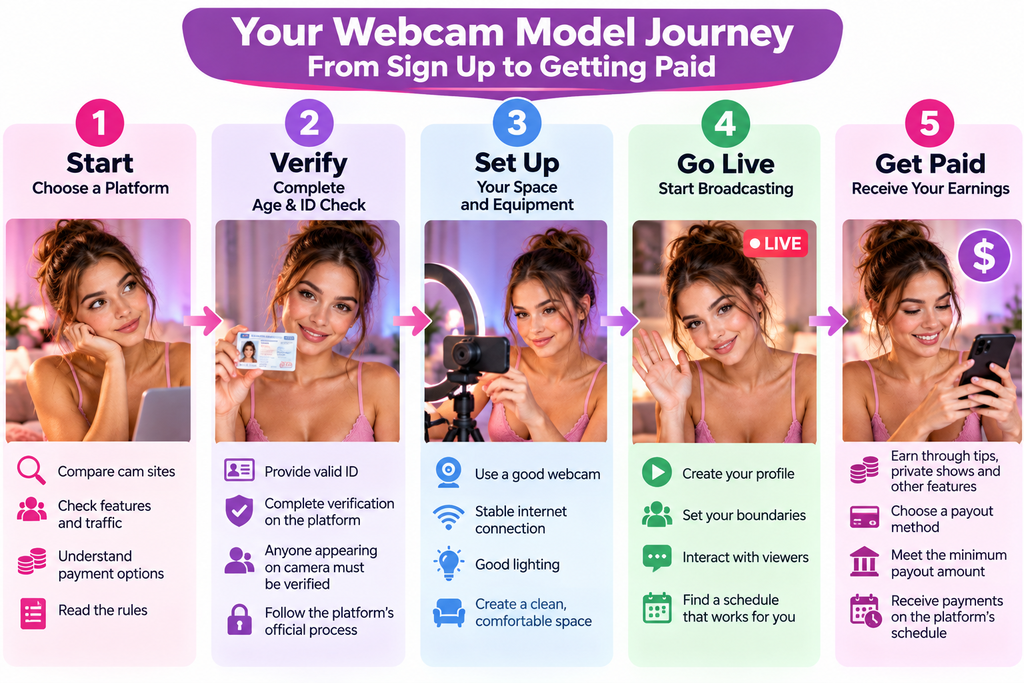
Step 3: Complete Age and Identity Verification
Legitimate adult cam platforms require performers to meet their age requirements and complete identity verification.
Expect to provide valid identification and possibly additional identity checks.
For example, Chaturbate’s current broadcaster documentation requires a valid government-issued ID with the performer’s date of birth, legal name, and photograph, along with a selfie verification process. Anyone appearing in a broadcast must also be properly verified.
Requirements differ by platform and country, so always follow the platform’s current instructions.
Never attempt to bypass age or identity verification.
Also make sure you’re registering through the platform’s legitimate website rather than sending identification documents to someone who contacts you privately.
Step 4: Create a Separate Model Identity
If privacy matters to you, separating your model identity from your personal identity is one of the smartest things you can do before your first broadcast.
Consider creating:
- A stage name
- A separate email address
- Separate social-media accounts used only for your model identity
- Strong, unique passwords
- Two-factor authentication where available
Avoid casually revealing details such as your home address, personal phone number, workplace or other information that could identify your location.
Think carefully about what appears in your camera background too. Mail, photographs, windows, certificates and distinctive views can reveal more than you realize.
Step 5: Set Your Boundaries Before You Go Live
One of the most important parts of preparing for cam work has nothing to do with technology.
Decide your boundaries.
Write down what you’re comfortable doing, what you might consider and what you will not do.
You do not have to change those boundaries because a viewer offers money.
Clear boundaries can also make broadcasting easier because you’re not making every decision under pressure while people are watching.
Learn the platform’s rules, too. Your personal boundaries can be stricter than the site’s rules, but they cannot override activities the platform prohibits.
Step 6: Get the Basic Equipment
You don’t need to build a professional studio before you know whether cam modelling suits you.
A beginner setup usually needs four things:
Computer or suitable device: It should handle a stable live stream.
Webcam: A good HD webcam is sufficient for many beginners.
Internet connection: Stability matters more than an impressive advertised maximum speed.
Lighting: Good lighting can improve your image dramatically, sometimes more noticeably than upgrading your camera.
Audio matters too. If viewers struggle to hear you clearly, conversation becomes difficult.
Start with equipment you can reasonably afford. Upgrade after you understand what actually limits your broadcasts.
Step 7: Create a Simple Broadcasting Space
Your room does not have to look like a professional studio.
It should look deliberate.
Remove distracting clutter and anything that reveals personal information. Position your camera where you can move comfortably, and make sure your lighting illuminates you rather than a bright window behind you.
Test what viewers will see before you go live.
A simple, tidy room with flattering lighting often looks better than an elaborate setup with poor camera placement.
Your background can eventually become part of your brand.
Step 8: Test Everything Before Your First Broadcast
Do a complete technical test before going live.
Check:
- Camera framing
- Focus
- Lighting
- Microphone volume
- Internet stability
- Background
- Notifications appearing on your computer
- Whether personal information is visible
Move around the room rather than testing only while sitting perfectly still.
If you plan to broadcast from a bed, chair and standing position, check all three camera angles beforehand.
A few minutes of preparation can prevent an uncomfortable first stream.
Step 9: Create Your Profile
Your profile helps viewers understand who you are before they interact with you.
You don’t need to invent an elaborate fictional personality.
Instead, explain your style and interests while protecting information you want to keep private.
A useful beginner profile might include your stage name, general interests, broadcasting style and approximate schedule.
Good profile photos can help, but don’t publish anything you wouldn’t be comfortable having associated with your model identity elsewhere online.
Step 10: Plan Your First Broadcast
Your first stream doesn’t need to be perfect.
Set a simple goal: get comfortable with the platform.
Learn where the controls are. Practice reading chat while staying engaged with viewers. See how your camera looks after broadcasting for an extended period.
Conversation is especially valuable when your room is quiet.
Instead of waiting silently for someone to tip, greet viewers and give them something to respond to.
It may take time for broadcasting to feel natural.
How Do Webcam Models Make Money?
Earning systems vary by platform.
Common methods can include:
- Viewer tips
- Private shows
- Fan clubs or subscriptions
- Paid photos and videos
- Premium messages or content
- Other platform-specific features
On token-based platforms, viewers buy virtual tokens, and models receive a defined value when eligible tokens convert.
For example, Chaturbate currently documents a broadcaster conversion rate of $0.05 per token.
That does not mean every cam platform pays the same way.
Before broadcasting anywhere, understand what the viewer pays, what you receive, when earnings become withdrawable and whether payment-processing fees apply.
How Much Can a Beginner Webcam Model Make?
There is no reliable single figure.
Income can vary dramatically between models and even between different weeks for the same model.
Factors can include:
- Hours broadcast
- Schedule consistency
- Number of viewers
- Returning customers
- Communication skills
- Private-show activity
- Pricing
- Platform traffic
- Competition
- Paid-content sales
- Experience
Be skeptical of articles or recruiters that promise a specific income.
A screenshot showing one model’s exceptional earnings does not tell you what a typical beginner will earn.
For someone starting, it is safer to treat camming as an experiment rather than immediately depending on it as a full-time income.
We can eventually link this section to our planned How Much Do Webcam Models Make? article, where we’ll research earnings in much greater detail.
How Do Webcam Models Get Paid?
Payment methods depend on both the platform and your country.
Options may include bank transfers, payment services, checks or other methods.
Minimum withdrawal amounts and processing fees can vary by method.
For example, Chaturbate offers semi-monthly payouts and lists several payout methods. Most listed methods currently start at a $50 minimum, although some have higher minimums and different fees.
That is why you should check payment options before spending significant time building an account.
Ask:
Can I receive this payment method in my country?
What is the minimum payout?
What fees apply?
How long does payment normally take?
Will currency conversion cost me money?
And don’t assume the payment system you read about in an old blog post is still available. Payment providers and platform policies change.
Build a Stronger Cam Model Routine
Explore our Cam Model Resources for practical guides on scheduling, consistency, room setup, privacy, earnings, and more.
Protecting Your Privacy as a Webcam Model
Perfect anonymity cannot be guaranteed once you broadcast publicly.
But you can reduce unnecessary exposure.
Keep personal and model accounts separate. Avoid showing identifying documents or information on camera. Use unique passwords and enable additional account security where possible.
Some platforms offer geographic restrictions or blocking tools. These may reduce exposure in selected areas, but they should not be treated as a guarantee that nobody from that location will ever see your content.
Your safest assumption is that anything broadcast publicly could be seen or recorded by someone you didn’t expect.
That doesn’t mean you shouldn’t model. It means you should decide with confidence.
For a broader look at online privacy and security when using cam platforms, see our Live Cam Site Safety & Privacy Guide.
Watch for Scams and Fake Recruiters
New models can be attractive targets for scammers because they may not yet know how platforms normally operate.
Be cautious if someone:
- Promises guaranteed income
- Requests your password
- Asks you to send identification directly to them without a legitimate reason
- Demands upfront payment to get you accepted
- Pressures you to move conversations away from the official platform
- Promises special treatment that you cannot verify
When possible, confirm important requirements directly through the platform’s official documentation or support system.
Treat Cam Modeling Like a Small Business
Even if you begin casually, keeping basic records is worthwhile.
Track your income, platform statements, payment-processing fees and business-related expenses.
Tax obligations depend on where you live and your individual circumstances. Don’t assume that online income is automatically tax-free simply because a platform or payment processor is located in another country.
If your income becomes meaningful, consider getting advice from a qualified tax professional familiar with self-employment or online creator income in your jurisdiction.
Consistency Usually Matters More Than One Long Broadcast
Beginners sometimes assume success requires being online constantly.
A predictable schedule can be more useful than broadcasting randomly whenever you have spare time.
If viewers enjoy your room but never know when you’ll return, building a repeat audience becomes harder.
Start with a schedule you can actually maintain.
Three manageable sessions every week may be more sustainable than trying to broadcast every day and quickly burning out.
Learn From Each Broadcast
Your early broadcasts are useful information.
Notice when viewers arrive, what starts conversations, which camera angles work, when your room becomes more active and which parts of broadcasting you enjoy.
Don’t judge the entire opportunity from one good or bad session.
Make small improvements.
Better lighting this week.
A clearer profile next week.
A more consistent schedule after that.
Over time, those changes can matter more than buying expensive equipment immediately.
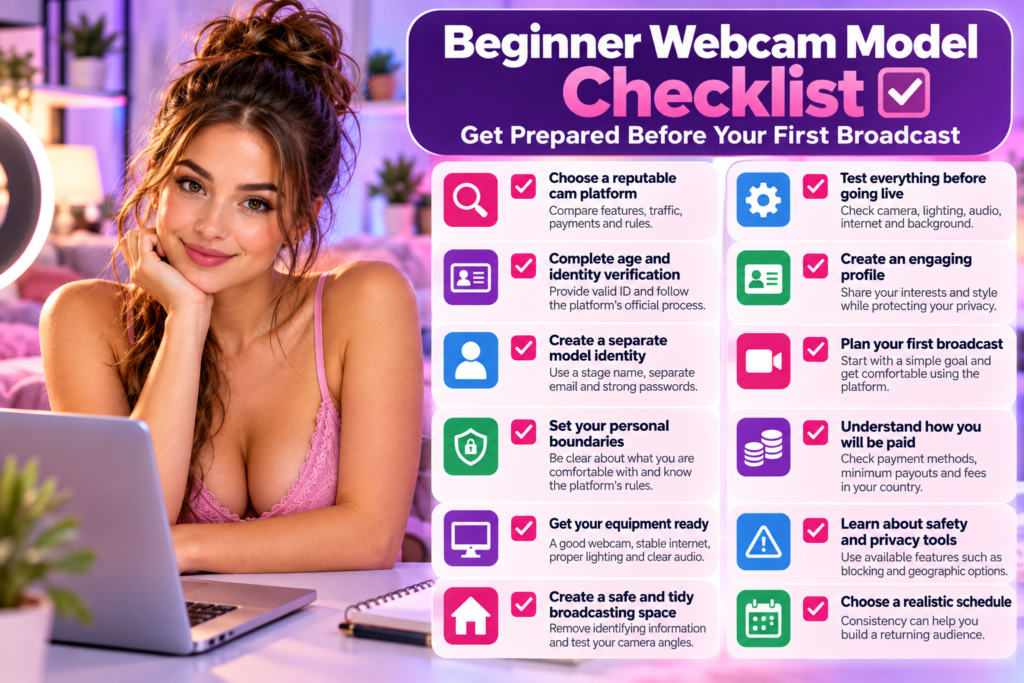
Beginner Webcam Model Checklist
Before your first serious broadcast, make sure you have:
- Chosen a reputable platform
- Read its performer rules
- Completed the required age and identity verification
- Confirmed how you’ll receive payments
- Created a separate model identity
- Set your personal boundaries
- Tested your camera and microphone
- Improved your lighting
- Removed identifying information from the background
- Created a basic profile
- Decided on a realistic schedule
- Learned the platform’s safety and privacy controls
You don’t need everything to be perfect.
You should understand what you’re getting into before you press Go Live.
Final Thoughts
Learning how to become a webcam model involves much more than buying a webcam.
The strongest starting point is preparation: understand the platform, protect your privacy, set boundaries, learn how payments work, and start with equipment you can comfortably afford.
Don’t assume instant success, and don’t measure yourself against established models who may have spent years building an audience.
Your first goal should be simpler: create a safe, professional setup and learn whether you actually enjoy the work.
From there, you can improve your equipment, develop your on-camera style and decide whether cam modeling is something you want to pursue more seriously.